%20(3)_edited_edited.png)


The Ultimate Guide to Pipeline Automation: Everything You Need to Succeed Without Adding Headcount
- Peter Casey
- Mar 25
- 5 min read

In the modern business landscape, the traditional response to a stagnating sales pipeline has been to "hire your way out of the problem." Companies often believe that more boots on the ground: more SDRs, more account executives, and more managers: will inevitably lead to more revenue. However, this approach carries significant corporate risk, increases overhead, and often leads to a bloated payroll that eats into your bottom line.
True scalability in 2026 is not about increasing your headcount; it is about increasing your efficiency. By leveraging pipeline automation and strategic sales automation, you can transform your revenue engine into a high-output system that operates with surgical precision.
At Bullpen Business, we specialize in helping mid-market and Fortune 1000 organizations navigate this transition. By connecting companies with boutique firms and expert partners, we allow you to improve profitability without the traditional growing pains of internal expansion.
The Shift from Manual Labor to Strategic Output
Pipeline automation is the use of software and integrated systems to automatically handle data movement, processing, and delivery across your sales and marketing stack. Instead of your sales team spending 60% of their day on administrative tasks, automation ensures that data moves where it needs to go, triggered by specific events or schedules.
The core philosophy is simple: Reallocate rather than hire.
When you automate the repetitive work of data entry, lead enrichment, and follow-up scheduling, your existing team members are freed to focus on high-value activities like product innovation, complex problem-solving, and closing deals. Research shows that organizations focusing on automation can reduce data processing time by as much as 40%. This recovered time is essentially "free" labor that you already pay for, now redirected toward growth.

1. CRM Automation: The Foundation of Scale
Your CRM should be your "source of truth," yet for many businesses, it is a "source of frustration." Manual sales tracking is prone to human error, inconsistent data, and the inevitable "ghost departments" where information goes to die.
CRM automation eliminates these bottlenecks. By enforcing validation rules at every stage of the funnel, the system catches anomalies before they become systemic problems. Whether it is updating a lead status after a call or triggering a nurture sequence based on a website visit, automation ensures consistency.
If you are currently debating between manual tracking and automated systems, it is important to understand the long-term impact on your data integrity. For a deeper dive into this comparison, see our analysis on CRM automation vs. manual sales tracking.
2. B2B Lead Generation Services: Outsourcing the Search
One of the most labor-intensive parts of the sales cycle is the initial prospecting. Building lists, verifying emails, and identifying the right decision-makers can take hundreds of hours per month. Attempting to do this entirely in-house often leads to burnout and high turnover.
By utilizing professional B2B lead generation services, you tap into specialized boutique firms that have perfected the art of the "first touch." Bullpen Business acts as the bridge here. We connect you with vendors who provide high-quality, verified leads that feed directly into your automated pipeline.
This allows your internal team to step in only when a lead is qualified and ready for a conversation, rather than wasting time on cold outreach that yields low returns. This shift alone can significantly lower your cost per acquisition.
3. Sales Automation: Turning Software Bloat into Capital
A common mistake many executives make is purchasing "all-in-one" software suites that promise the world but deliver massive "bloatware." You end up paying for 50 features when you only need three.
Effective sales automation is about the "Partner Stack": a curated selection of tools and services that work together seamlessly. At Bullpen Business, we advocate for a transparent, vendor-neutral model. Our goal is to help you identify the specific tools that will provide immediate working capital by reducing manual effort and eliminating redundant software costs.
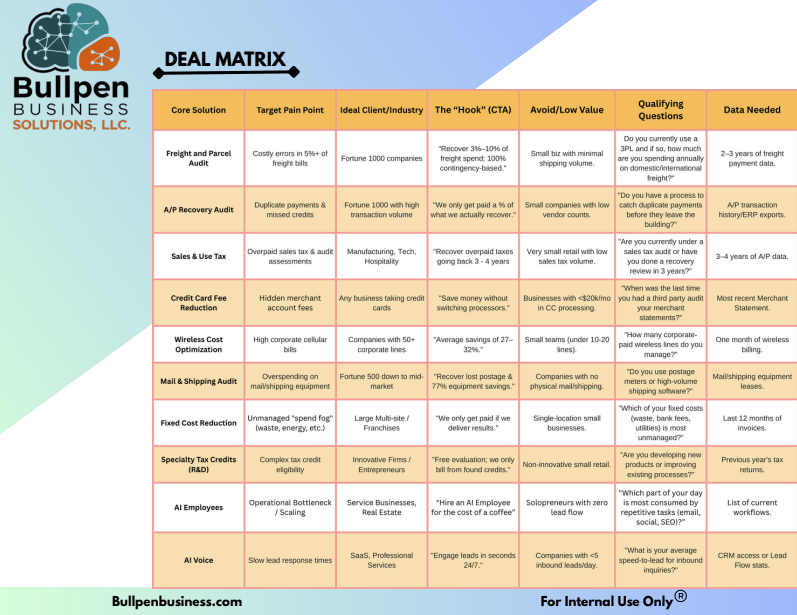
As shown in our Deal Matrix, identifying the right solution starts with understanding your specific pain points: whether it's IT costs, payroll complexity, or a dry sales pipeline. By selecting targeted automation tools, you restore capacity to your team without adding to your corporate career risk.
4. Appointment Setting Services: The Bridge to Closing
Even with the best leads, the "back-and-forth" of scheduling can stall a deal. This is where appointment setting services and automated scheduling tools come into play.
By automating the coordination of meetings across different time zones and departments, you simplify a complex logistical hurdle. When integrated with your pipeline, an appointment setter or an automated tool can book meetings directly onto your sales team’s calendars the moment a lead shows intent.
This creates a "frictionless" experience for the prospect. They don't have to wait for a call back; the meeting is set, the data is in the CRM, and your salesperson walks into the meeting with all the context they need.
The Financial Impact of Pipeline Automation
The benefits of moving toward an automated model are not just operational: they are financial.
Increased Productivity: Your current staff can handle a higher volume of leads and accounts, effectively increasing your "revenue per employee" metric.
Scalability: Automated pipelines adapt to growing data volumes. Whether you are handling 100 leads or 10,000, the infrastructure remains the same.
Cost Savings: By reducing error rates and manual intervention, organizations often see substantial operational savings. In some sectors, automation has reduced ongoing costs by over 50%.
Real-Time Monitoring: Dashboards provided by these systems offer immediate visibility into your pipeline. You can identify bottlenecks, such as a high drop-off rate at the proposal stage, and fix them before they impact your quarterly goals.
For those just starting this journey, we recommend following a structured path to avoid overwhelm. You can find a step-by-step framework in The Beginner's Guide to Pipeline Automation.
Implementation Essentials: How to Succeed Without the Headache
To implement these changes without disrupting your current operations, focus on these four pillars:
Audit Your Current Process: Where are your people spending the most time? If it’s data entry, start with CRM automation. If it’s finding prospects, look at B2B lead generation services.
Integrate, Don't Replace: Choose tools that "talk" to your existing technology stack. You don't want to create new silos of information.
Focus on Quality Over Quantity: Automation allows you to move faster, but it also allows you to move faster in the wrong direction. Ensure your automated triggers are based on high-quality data.
Leverage Expert Partners: You don't have to build this alone. Bullpen Business connects you with a curated ecosystem of vendors who have already solved these problems for companies like yours.
Why Bullpen Business?
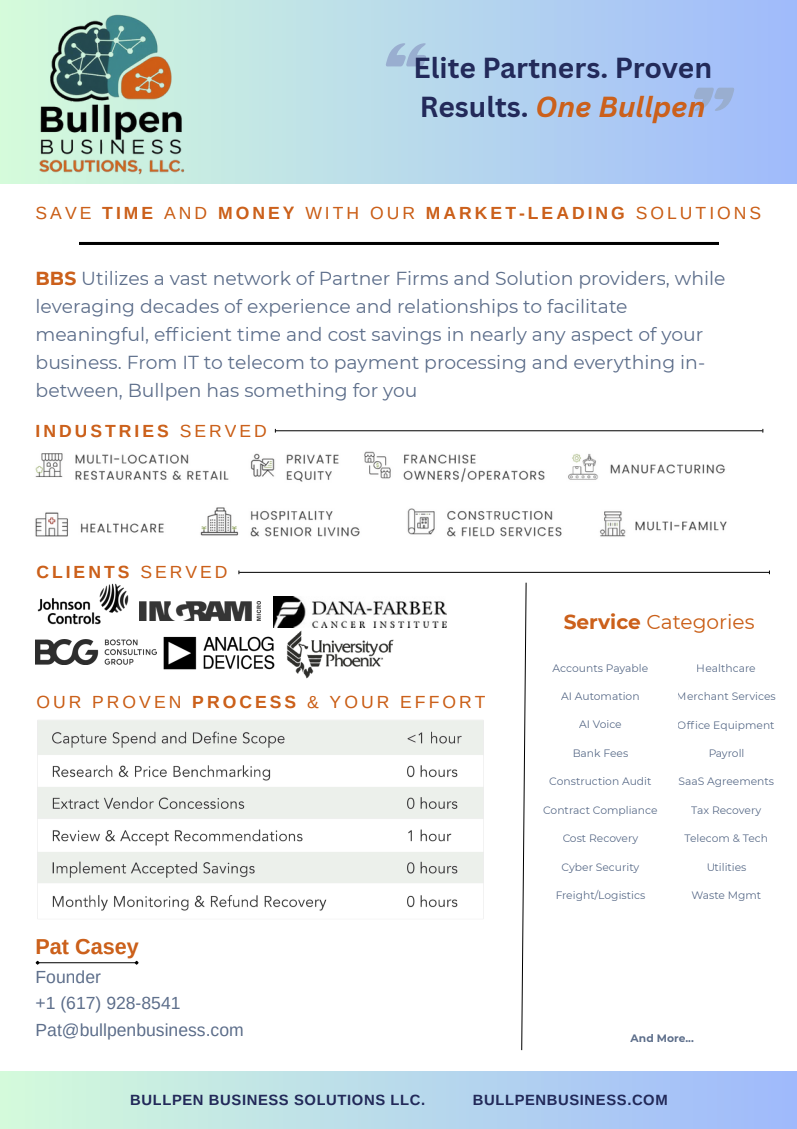
Our model is built on transparency and profitability. We understand that as a leader, you are responsible for the bottom line. Adding headcount is a permanent increase in fixed costs; adding automation is a strategic investment in variable output.
We offer a curated vendor ecosystem and negotiated deals that are typically reserved for the largest corporations. By joining our network, you gain access to market-leading solutions in cost recovery, IT, and sales automation, all designed to improve your company’s EBITDA.
Whether you are struggling with "software bloat" or simply cannot find enough qualified talent to fuel your growth, pipeline automation is the answer. It allows you to scale your impact while keeping your team lean, focused, and high-performing.
To explore how we can help you integrate these solutions into your current workflow, you can meet with our team here to discuss your specific needs.
The future of business growth isn't about how many people you have in the building; it’s about how much work you can get done while they aren't even there. Pipeline automation makes that possible.
Comments