%20(3)_edited_edited.png)


7 Mistakes You’re Making with Sales Automation (And How to Fix Them Using Found Money)
- Peter Casey
- May 5
- 5 min read

In the current business landscape of 2026, the mandate for every executive is clear: do more with less while driving higher profitability. Sales automation has long been touted as the "silver bullet" for scaling outreach and streamlining workflows. However, most companies are approaching it from a position of deficit. They implement complex systems, hope for the best, and eventually watch their ROI dwindle because the foundation was cracked from the start.
At Bullpen Business, we see a recurring pattern. Companies want to invest in B2B lead generation services and pipeline automation, but they feel they lack the liquid capital to execute a world-class strategy. This is where the concept of "Found Money" comes in. By identifying overspent areas in your current operations: such as wireless expenses, freight costs, or unclaimed tax credits: you can fund a high-performing sales engine without touching your existing budget.
But even with the budget in place, automation is a double-edged sword. If you don't address these seven common mistakes, you're simply accelerating your path to a clogged pipeline.

1. Automating a Broken Sales Process
The most common mistake we see is the "digital transformation" of a mess. If your manual sales process is disorganized, inconsistent, or lacks clear stages, automating it only makes the dysfunction happen faster. Automation is a force multiplier; if the input is zero (or negative), the output will be, too.
Before you look for sales automation tools, you must map your existing workflow. Identify where leads drop off and where your team spends too much time on administrative tasks. Once the process is lean, then you apply the technology.
2. The "Set and Forget" Mentality
Many leaders view CRM automation as a kitchen appliance: you plug it in, turn it on, and walk away. In reality, automation requires constant auditing. Market conditions change, buyer personas evolve, and email algorithms become more sophisticated.
If you aren't periodically reviewing your automated sequences, you are likely sending outdated messaging to prospects who have moved on. A professional approach requires a monthly audit of your analytics to ensure your pipeline automation is actually moving deals toward a close, rather than just filling your CRM with "dead" activity.
3. Sacrificing Personalization for Volume
We have all been on the receiving end of a "robotic" B2B outreach email. It’s cold, generic, and immediately deleted. In 2026, prospects demand a higher level of relevance. One of the biggest mistakes in B2B lead generation services is prioritizing the number of emails sent over the quality of the connection made.
The fix is segmenting your lists and using behavior-triggered automation. Instead of a blast, use "if/then" logic. If a prospect downloads a specific whitepaper, the automation should trigger a highly relevant follow-up related to that specific topic. This level of sophistication is what separates boutique firms from the "spray and pray" agencies.
4. Ignoring Data Hygiene and Integrity
Your automation is only as powerful as your data. Poor data: duplicates, outdated emails, and incorrect job titles: is the silent killer of profitability. When you run automated campaigns on "dirty" data, your bounce rates spike, and your domain reputation suffers.
A successful CRM automation strategy must include regular data cleansing. At Bullpen Business, we often find that companies are sitting on massive databases that are 40% obsolete. Cleaning this data and enriching it with accurate contact info is often the fastest way to see an immediate jump in your appointment setting services performance. You can read more about how this impacts your growth in our guide on why sales process automation will change the way you close deals.
5. Attempting to Automate Everything at Once
It is tempting to want a fully autonomous sales machine by next Tuesday. However, the "Big Bang" approach to implementation usually leads to team burnout and system failure. When you try to automate lead scoring, outreach, meeting scheduling, and contract renewals all at once, you lose visibility into what is actually working.
The professional fix is a phased rollout. Start with high-impact, low-complexity tasks like appointment setting services or initial lead follow-ups. Once those are stable and profitable, move to more complex stages of the funnel. This incremental approach ensures your team actually adopts the tools rather than resenting them. For a deeper dive into this, check out our beginner's guide to mastering pipeline growth.
6. Using the Wrong Tools for the Task
The market is flooded with SaaS platforms promising the world. Many companies end up with a "Frankenstein" tech stack: tools that don't talk to each other and require constant manual intervention to sync. This defeats the entire purpose of automation.
Selecting the right boutique firm to manage your tech stack is crucial. You don't need the most expensive software; you need the most integrated software. We specialize in connecting you with firms that understand how to build a cohesive ecosystem where your B2B lead generation services feed directly into your CRM without friction.
7. Automating High-Value Human Touchpoints
There is a limit to what machines should do. For high-ticket B2B deals, there comes a point where a human must step in to build rapport, handle complex objections, and close the deal. Automating the "final mile" of a sales process often feels cold to the buyer and can kill a deal that was 90% of the way there.
Use automation for the "grunt work": the scheduling, the reminders, the data entry: so your high-value sales talent can focus on actual selling. This balance is the secret to high-margin profitability. To see how this balance compares to adding more staff, read our analysis on sales automation vs. headcount.
The "Found Money" Strategy: Funding Your Future
The most significant barrier to fixing these mistakes is often the perceived cost. Business owners frequently ask, "How can I afford a boutique automation firm when my margins are already tight?"
This is where Bullpen Business changes the game. We don't just recommend services; we help you find the capital to pay for them. By conducting audits in non-sales areas, we identify significant savings that act as "found money."
Consider this case study: A nationwide retailer was able to reduce their wireless expenses by over $18,000 per month through a simple optimization audit.
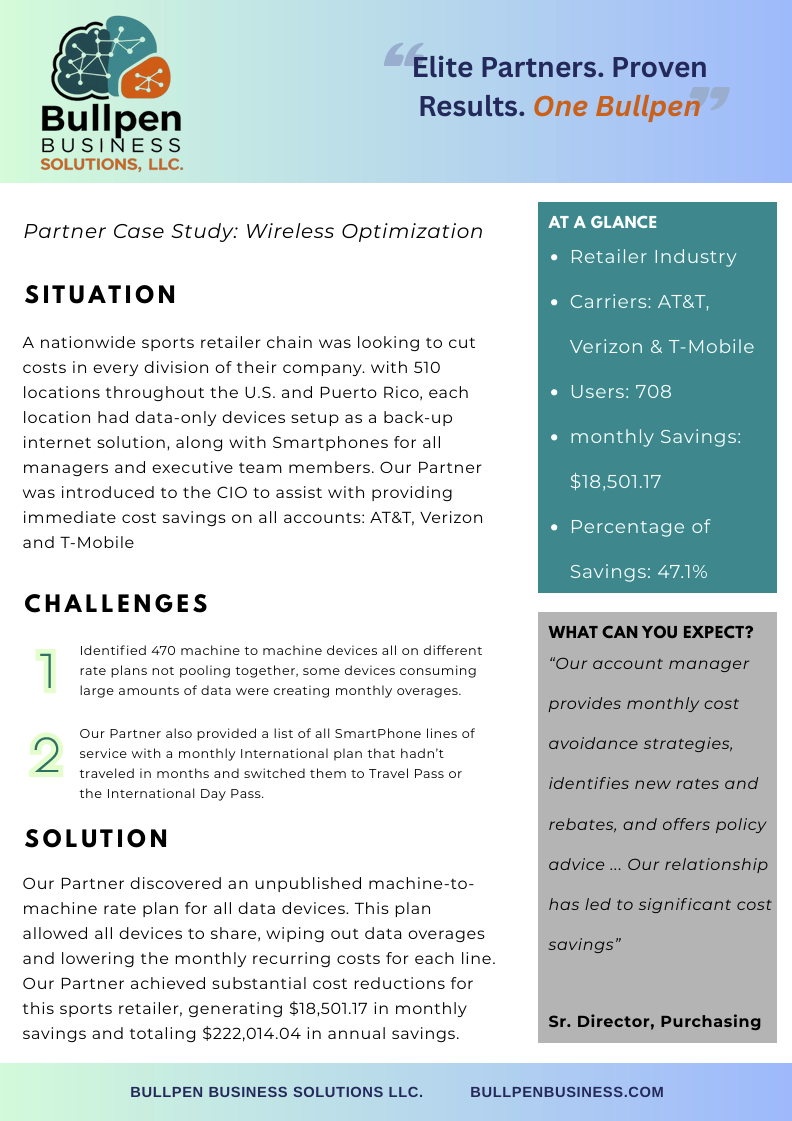
That $18,000 monthly "found money" was then reinvested into professional pipeline automation and B2B lead generation services. They didn't increase their budget; they simply moved money from a "waste" column to a "growth" column.
How to Get Started
Fixing your sales automation doesn't have to be a daunting, expensive project. It starts with a shift in perspective.
Audit your current costs: Use Bullpen’s network of boutique firms to find hidden savings in your A/P, taxes, or utilities.
Reinvest in strategy: Take that found money and apply it to a professional sales automation strategy.
Partner with experts: Don't try to DIY your CRM. Connect with a specialized firm that can implement the 7 fixes mentioned above.
When automation is handled professionally, it doesn't just save time: it creates a predictable, scalable engine for revenue. If you're ready to stop making these common mistakes and start finding the hidden ROI in your business, it’s time to look at your pipeline through a new lens.
For more information on building a strategy that pays for itself, explore our ultimate guide to sales automation or meet with our team to begin your cost-recovery audit today.
Comments