%20(3)_edited_edited.png)


The Ultimate Guide to Sales Automation: How to Scale Without Increasing Your Corporate Career Risk
- Peter Casey
- Mar 23
- 5 min read

Scaling a B2B organization is often viewed as a direct correlation between headcount and revenue. The traditional logic suggests that to double your sales, you must double your sales force. However, in the modern corporate landscape, increasing headcount brings significant baggage: higher overhead, complex management layers, and increased corporate career risk for the leaders overseeing these expansions.
Sales automation provides a strategic alternative. By leveraging technology and specialized external partners, organizations can achieve exponential growth in output without the linear growth in internal costs. At Bullpen Business, we specialize in navigating this transition, connecting mid-market and Fortune 1000 companies with boutique firms that provide the specialized expertise needed to drive profitability through efficiency.
1. Understanding Corporate Career Risk in Sales Scaling
The primary risk for any Director, VP, or C-suite executive tasked with growth is the "failed transformation." Many organizations attempt to solve scaling issues by purchasing expensive, enterprise-level software that promises to automate everything. When these tools are not properly integrated or fail to gain team adoption, they become "bloatware": expensive line items that drain capital without producing a return on investment (ROI).
When an executive spearheads a multi-million dollar software rollout that fails to produce results, it creates a significant stain on their professional record. This is what we define as corporate career risk. To mitigate this, leaders must move away from "software-first" thinking and toward a "process-first" strategy supported by sales automation tools.
By focusing on modular, high-impact changes rather than massive internal overhauls, you can scale your operations while keeping your risk profile low.
2. The Core Pillars of Sales Automation
To scale effectively, an organization must automate three critical areas: data management, lead engagement, and pipeline movement.
CRM Automation
The CRM is the heart of the sales organization, yet it is often the greatest source of manual labor. Sales representatives frequently spend up to 30% of their time on administrative tasks rather than selling. CRM automation involves setting up workflows that automatically update deal stages, log communications, and trigger internal notifications.
Pipeline Automation
A healthy sales pipeline requires constant movement. If a lead sits in "Discovery" for three weeks without contact, the probability of closing drops significantly. Pipeline automation ensures that every prospect receives timely follow-ups based on their specific behavior, such as opening an email or downloading a whitepaper.
Appointment Setting Services
The "top of the funnel" is often the most labor-intensive part of the sales process. Rather than forcing your high-value account executives to spend their days cold calling, many successful firms utilize appointment setting services. This allows your internal team to focus exclusively on closing deals, while specialized boutique firms handle the initial outreach and qualification.

3. Scaling Lead Generation Without the Headcount
The most common mistake in B2B scaling is hiring more sales development representatives (SDRs) to handle lead generation. This adds to the "ghost department": a team that exists on the payroll but produces inconsistent results due to high turnover and training lag.
Instead, companies are increasingly turning to B2B lead generation services. These external partners bring their own technology stacks, data sets, and proven methodologies. This shift allows you to:
Reduce Recruitment Costs: You no longer need to spend months finding and training entry-level sales staff.
Improve Data Quality: Boutique firms often have access to superior intent data that identifies companies currently in a buying cycle.
Gain Immediate Capacity: External firms can often launch a campaign in weeks, whereas building an internal team takes quarters.
For a deeper dive into how this affects your bottom line, consider our analysis on how to turn software bloat into immediate working capital.
4. The Bullpen Business Advantage: Connecting with Boutique Expertise
Bullpen Business acts as the bridge between your corporate objectives and the specialized boutique firms that can execute them. We recognize that the "one-size-fits-all" approach of major consulting firms often misses the nuances of specific industries.
Our model is built on a curated ecosystem of vendors who provide everything from AI-driven voice automation to sophisticated pipeline automation. By working with us, you gain access to negotiated deals and a transparent, vendor-neutral model that ensures you are getting the best solution for your specific pain points.
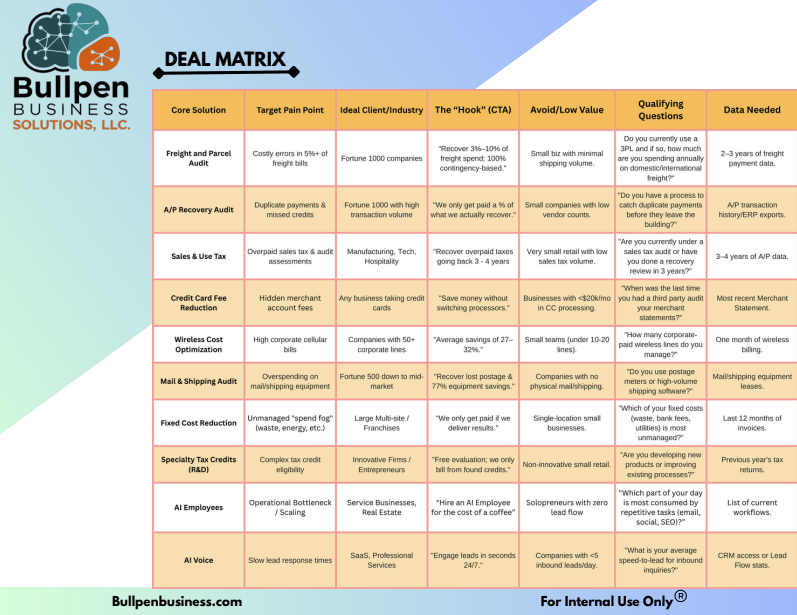
As shown in our Deal Matrix, we help Alpha Agents and corporate leaders identify core solutions: ranging from tax credits to AI employees: that address specific financial and operational inefficiencies. This structured approach allows you to implement sales automation in a way that is both measurable and low-risk.
5. Implementing a Sales Automation Framework
To successfully integrate these tools without disrupting your current operations, we recommend a phased approach:
Phase 1: Audit the Existing Process
Identify where your current team is losing time. Are they manually searching for contact info? Are they writing the same follow-up emails manually? Use this data to justify the initial investment in automation.
Phase 2: Select Your "Partner Stack"
Do not try to build everything in-house. A successful sales automation software stack usually involves three key partners: a data provider, an outreach platform, and an integration specialist.
Phase 3: Optimize Lead Management
Ensure that your B2B lead generation services are tightly integrated with your CRM. Leads should flow seamlessly from the external partner to your internal closers without manual intervention.
Phase 4: Reclaim and Reinvest Capacity
Once automation is in place, monitor the "reclaimed time" of your sales staff. This time should be reinvested into high-impact activities like tailored proposal preparation and strategic relationship building.

6. The Long-Term ROI: Profitability Over Presence
The ultimate goal of sales automation is not just to do things faster, but to do them more profitably. When you scale through automation and boutique partnerships, your "cost to acquire a customer" (CAC) remains stable or even decreases as you grow. In contrast, scaling through headcount usually leads to an increasing CAC due to the inefficiencies of management and overhead.
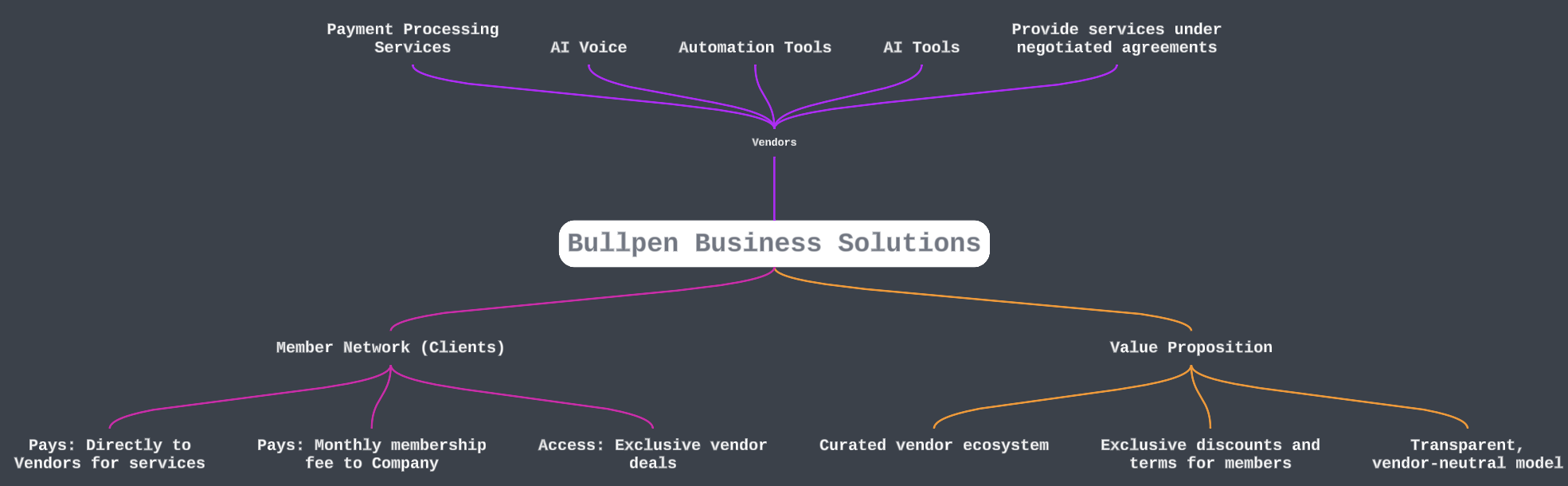
Our curated vendor network, as illustrated in the mind map above, provides the tools necessary to maintain a lean, high-output organization. By utilizing negotiated services and exclusive discounts, our members can implement world-class sales automation at a fraction of the cost of building these systems from scratch.
7. Conclusion: Strategic Scaling for the Future
Scaling your sales organization does not have to be a high-stakes gamble with your corporate career. By leveraging CRM automation, professional appointment setting services, and external lead generation partners, you can drive significant revenue growth while maintaining a lean internal team.
At Bullpen Business, we are dedicated to helping companies achieve this balance. We provide the connections, the expertise, and the framework to turn your sales department into a profit center rather than a cost center.
If you are struggling with consistent pipeline growth or want to explore how boutique firms can fix your CRM issues, we invite you to explore our resources. From 50 sales automation tools to our proven 90-day revenue framework, we have the roadmap you need to scale safely and successfully.
Comments